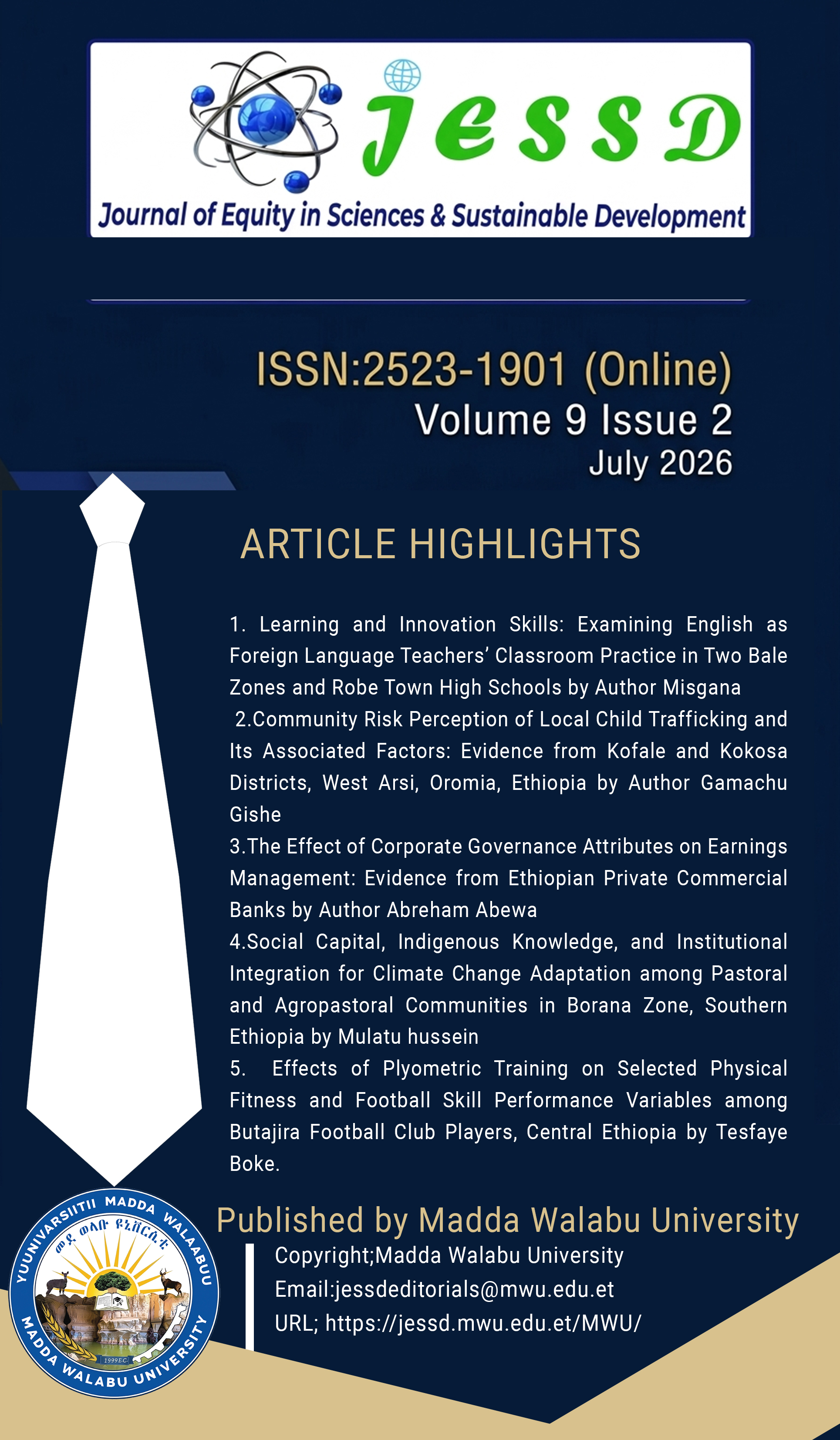
The Effect of Corporate Governance Attributes on Earnings Management: Evidence from Ethiopian Private Commercial Banks
DOI:
https://doi.org/10.20372/mwu.jessd.2026.1601Keywords:
Corporate governance, Earnings management, Ethiopian Bank, GMMAbstract
This study investigates the effect of corporate attributes on earnings management in Ethiopian private commercial banks. Specifically, it examines the effects of board attributes (size, gender diversity, and meeting regularity) and audit committee features (size, meeting frequency, financial competence, and independence) on earnings management measured by discretionary loan loss provisions. This study employs a quantitative research method using balanced panel data obtained from 16 Ethiopian private commercial banks covering the period from 2015 to 2024. Secondary data were obtained from the National Bank of Ethiopia and the annual reports of sampled private commercial banks. To overcome the issue of unobserved endogeneity and heteroscedasticity, the one-step system GMM estimator is applied. The findings show that more frequent board meetings, audit committee financial expertise, audit committee size, and audit committee independence are significantly related to lower earnings management (P < 0.01). Similarly, the results of the study reveal that the frequency of audit committee meetings has a statistically significant negative effect on earnings management (P < 0.05). The result also indicates that the first lag of discretionary loan loss provision and return on assets has a significant positive effect on earnings management as measured by discretionary provision at (P < 0.05) and (P < 0.01), respectively. In contrast, board size, female board representation, financial leverage, and firm size were not found to have a noticeable effect. This study is limited to only seven governance variables and sixteen private commercial banks. Future studies may incorporate additional governance attributes and other entities. The results provide valuable insight to managers, regulators, and policymakers who need to enhance the governance framework and reduce opportunistic financial reporting, while also contributing to the literature on corporate governance in developing countries like Ethiopia.
Downloads
References
Abbott, L. J., Parker, S., & Peters, G. F. (2004). Audit Committee Characteris-tics and Restatements. AUDITING: A Journal of Practice & Theory, 23(1), 69–87. https://doi.org/10.2308/aud.2004.23.1.69
Abdou, H. A., Ellelly, N. N., Elamer, A. A., Hussainey, K., & Yazdifar, H. (2021). Corporate governance and earnings management nexus: Evidence from the UK and Egypt using neural net-works. International Journal of Fi-nance & Economics, 26(4), 6281–6311. https://doi.org/10.1002/ijfe.2120
Abraham Lincoln Ayisi, Zhang Wenfang, Jo-seph Adu-Gyamfi, Agyemang Kwasi Sampene, & Ofori Charles. (2021). Accrual earnings management, real earnings management and firm per-formance: A panel data analysis. EPRA International Journal of Eco-nomics, Business and Management Studies, 37–47. https://doi.org/10.36713/epra7078
Abu Siam, Y., Idris, M., & Al- Okdeh, S. (2018). The moderating role of family control on the relationship between audit committee financial expertise and earnings management. Interna-tional Journal of Business and Man-agement, 13(12), 31. https://doi.org/10.5539/ijbm.v13n12p31
Adams, R. B., & Ferreira, D. (2009). Women in the boardroom and their impact on governance and performance☆. Journal of Financial Economics, 94(2), 291–309. https://doi.org/10.1016/j.jfineco.2008.10.007
Afonso Alves, C., Matias Gama, A. P., & Au-gusto, M. (2021). Family influence and firm performance: The mediating role of stewardship. Journal of Small Business and Enterprise Develop-ment, 28(2), 185–204. https://doi.org/10.1108/JSBED-01-2019-0015
African Development Bank. (2021). Ethiopia country focus report. African Devel-opment Bank Group.
Ahmad, I., Sadiqa, B. A., & Khan, R. (2021). The impact of corporate governance practices on the firm financial per-formance of the non-financial firms. Global Economics Review, VI(I), 53–70. https://doi.org/10.31703/ger.2021(VI-I).05
Akileng, G. (2014). The efficacy of corporate governance in reducing opportunistic accounting earnings manipulations.
Al Hajjar, C. A., Mokhtar, E. S., & Mandour, M. M. (2021). The impact of corpo-rate governance on earnings man-agement in Islamic and conventional banks. BAU Journal - Society, Cul-ture and Human Behavior, 2(2). https://doi.org/10.54729/2789-8296.1046
Albrecht, J. N., Haid, M., & Faisal, A. (2023). Agents or stewards? Non‐profit or-ganisations managing visitation: The case of New Zealand ecosanctuaries. International Journal of Tourism Re-search, 25(2), 279–292. https://doi.org/10.1002/jtr.2565
Aldamen, H., Hollindale, J., Duncan, K., Horrocks, M., & Ziegelmayer, J. L. (2024). Audit committee financial ex-pertise: Mitigation of real earnings management. International Journal of Accounting and Finance, 12(1/2), 110–130. https://doi.org/10.1504/IJAF.2024.143380
Aleqab, M. M., & Ighnaim, M. M. (2021). The impact of board characteristics on earnings management. Journal of Governance and Regulation, 10(3), 8–17. https://doi.org/10.22495/jgrv10i3art1
Alhadab, M. M., & Own, B. A.-. (2017). Earnings management and banks per-formance: Evidence from Europe. In-ternational Journal of Academic Re-search in Accounting, Finance and Management Sciences, 7(4), Pages 134-145. https://doi.org/10.6007/IJARAFMS/v7-i4/3444
Ali, A. (2024). Audit committee characteris-tics and earning management of in-surance companies in Ethiopia. Co-gent Business & Management, 11(1), 2301136. https://doi.org/10.1080/23311975.2023.2301136
Alkebsee, R. H., Tian, G., Garefalakis, A., Koutoupis, A., & Kyriakogkonas, P. (2022). Audit committee independ-ence and financial expertise and earn-ings management: Evidence from China. International Journal of Busi-ness Governance and Ethics, 16(2), 176. https://doi.org/10.1504/IJBGE.2022.121928
Almahrog, Y., Ali Aribi, Z., & Arun, T. (2018). Earnings management and corporate social responsibility: UK evidence. Journal of Financial Re-porting and Accounting, 16(2), 311–332. https://doi.org/10.1108/JFRA-11-2016-0092
Al-Musalli, M. A. K., & Ismail, K. N. I. K. (2012). Intellectual Capital Perfor-mance and Board Characteristics of GCC Banks. Procedia Economics and Finance, 2, 219–226. https://doi.org/10.1016/S2212-5671(12)00082-2
Alzoubi, E. S. S. (2018). Audit quality, debt financing, and earnings management: Evidence from Jordan. Journal of In-ternational Accounting, Auditing and Taxation, 30, 69–84. https://doi.org/10.1016/j.intaccaudtax.2017.12.001
Alzoubi, E. S. S. (2019). Audit committee, internal audit function and earnings management: Evidence from Jordan. Meditari Accountancy Research, 27(1), 72–90. https://doi.org/10.1108/MEDAR-06-2017-0160
Arellano, M., & Bover, O. (1995). Another look at the instrumental variable esti-mation of error-components models. Journal of Econometrics, 68(1), 29–51. https://doi.org/10.1016/0304-4076(94)01642-D
Assfaw, A. M., & Sharma, D. (2024). Does corporate governance spur bank intel-lectual capital in an emerging econo-my? A system GMM analysis from Ethiopia. Future Business Journal, 10(1), 8. https://doi.org/10.1186/s43093-023-00298-x
Attia, E. F., Ismail, T. H., & Mehafdi, M. (2022). Impact of board of directors attributes on real-based earnings management: Further evidence from Egypt. Future Business Journal, 8(1), 56. https://doi.org/10.1186/s43093-022-00169-x
Badolato, P. G., Donelson, D. C., & Ege, M. (2014). Audit committee financial ex-pertise and earnings management: The role of status. Journal of Ac-counting and Economics, 58(2–3), 208–230. https://doi.org/10.1016/j.jacceco.2014.08.006
Bamahros, D. H. M. (2016). Audit committee characteristics and unexpected accru-als: An empirical study of malaysia. 23(3).
Basel Committee on Banking Supervision. (2019). Pillar 2 framework: Supervi-sory review process. Bank for Inter-national Settlements.
Ben Othman, H., & Mersni, H. (2014). The use of discretionary loan loss provi-sions by Islamic banks and conven-tional banks in the Middle East re-gion: A comparative study. Studies in Economics and Finance, 31(1), 106–128. https://doi.org/10.1108/SEF-02-2013-0017
Blundell, R., & Bond, S. (1998). Initial con-ditions and moment restrictions in dynamic panel data models. Journal of Econometrics, 87(1), 115–143. https://doi.org/10.1016/S0304-4076(98)00009-8
Boachie, C., & Mensah, E. (2022). The effect of earnings management on firm per-formance: The moderating role of corporate governance quality. Inter-national Review of Financial Analy-sis, 83, 102270. https://doi.org/10.1016/j.irfa.2022.102270
Bouvatier, V., & Lepetit, L. (2008). Banks’ procyclical behavior: Does provision-ing matter? Journal of International Financial Markets, Institutions and Money, 18(5), 513–526. https://doi.org/10.1016/j.intfin.2007.07.004
Celtekligil, K. (2020). Resource Dependence Theory. In H. Dincer & S. Yüksel (Eds.), Strategic Outlook for Innova-tive Work Behaviours (pp. 131–148). Springer International Publishing. https://doi.org/10.1007/978-3-030-50131-0_7
Chen, Y.-S., Hsu, J., Huang, M.-T., & Yang, P.-S. (2013). Quality, size, and per-formance of audit firms. The Interna-tional Journal of Business and Fi-nance Research, 7(5), 89–105.
Cheung, K. Y., & Chung, C. V. (2022). The impacts of audit committee expertise on real earnings management: Evi-dence from Hong Kong. Cogent Business & Management, 9(1), 2126124. https://doi.org/10.1080/23311975.2022.2126124
Chouaibi, J., Harres, M., & Ben Brahim, N. (2018). The effect of board director’s characteristics on real earnings man-agement: Tunisian-listed firms. Jour-nal of the Knowledge Economy, 9(3), 999–1013. https://doi.org/10.1007/s13132-016-0387-3
Croci, E. (2018). The Board of Directors. In E. Croci, The Board of Directors (pp. 1–39). Springer International Publish-ing. https://doi.org/10.1007/978-3-319-96616-8_1
D. A., A., J. S., K., & R.O.C., S. (2011). Cor-porate governance and stakeholders interest: A case of Nigerian banks. In-ternational Journal of Business and Management, 6(10), p102. https://doi.org/10.5539/ijbm.v6n10p102
Djebali, N., & Zaghdoudi, K. (2020). Testing the governance-performance relation-ship for the Tunisian banks: A GMM in system analysis. Financial Innova-tion, 6(1), 23. https://doi.org/10.1186/s40854-020-00182-5
Donaldson, L., & Davis, J. H. (1991). Stew-ardship theory or agency theory: CEO governance and shareholder returns. Australian Journal of Management, 16(1), 49–64. https://doi.org/10.1177/031289629101600103
Drees, J. M., & Heugens, P. P. M. A. R. (2013). Synthesizing and Extending Resource Dependence Theory: A Me-ta-Analysis. Journal of Management, 39(6), 1666–1698. https://doi.org/10.1177/0149206312471391
Ebaid, I. E.-S. (2023). Board characteristics and the likelihood of financial state-ments fraud: Empirical evidence from an emerging market. Future Business Journal, 9(1), 47. https://doi.org/10.1186/s43093-023-00218-z
Eckles, D. L., He, E., Sommer, D. W., & Zhang, R. (2011). Earnings smooth-ing, executive compensation, and corporate governance: Evidence from the property–liability insurance indus-try. Journal of Risk and Insurance, 78(3), 761–790. https://doi.org/10.1111/j.1539-6975.2011.01417.x
Edesiri, G., & Confidence, J. (2020). Does earnings management exert pressure on firms’ return on assets and equity?: The case of Sub-Saharan Africa. Ekonomski Horizonti, 22(3), 221–233. https://doi.org/10.5937/ekonhor2003221O
Elghuweel, M. I., Ntim, C. G., Opong, K. K., & Avison, L. (2017). Corporate gov-ernance, Islamic governance and earnings management in Oman: A new empirical insights from a behav-ioural theoretical framework. Journal of Accounting in Emerging Econo-mies, 7(2), 190–224. https://doi.org/10.1108/JAEE-09-2015-0064
Eskerod, P. (2020). A stakeholder perspec-tive: Origins and core concepts. In P. Eskerod, Oxford Research Encyclo-pedia of Business and Management. Oxford University Press. https://doi.org/10.1093/acrefore/9780190224851.013.3
Farag, H., Mallin, C., & Ow-Yong, K. (2018). Corporate governance in Islamic banks: New insights for dual board structure and agency relationships. Journal of International Financial Markets, Institutions and Money, 54, 59–77. https://doi.org/10.1016/j.intfin.2017.08.002
Gajdosikova, D., Valaskova, K., & Durana, P. (2022). Earnings Management and Corporate Performance in the Scope of Firm-Specific Features. Journal of Risk and Financial Management, 15(10), 426. https://doi.org/10.3390/jrfm15100426
Galal, H. M., Soliman, M. M., & Bekheit, M. B. (2022). The Relation between Au-dit Committee Characteristics and Earnings Management: Evidence from Firms Listed on the Egyptian Stock Market. American Journal of Industrial and Business Management, 12(09), 1439–1467. https://doi.org/10.4236/ajibm.2022.129080
García-Sánchez, I.-M. (2010). The effective-ness of corporate governance: Board structure and business technical effi-ciency in Spain. Central European Journal of Operations Research, 18(3), 311–339. https://doi.org/10.1007/s10100-009-0112-4
Goel, S., & Kapoor, N. (2022). Is earnings management related to board inde-pendence and gender diversity? Sec-tor-wise evidence from India. Interna-tional Journal of Disclosure and Gov-ernance, 19(4), 363–373. https://doi.org/10.1057/s41310-021-00130-4
Gull, A. A., Nekhili, M., Nagati, H., & Chtioui, T. (2018). Beyond gender diversity: How specific attributes of female directors affect earnings man-agement. The British Accounting Re-view, 50(3), 255–274. https://doi.org/10.1016/j.bar.2017.09.001
Habbash, M. (2019). The role of corporate governance regulations in constrain-ing earnings management practice in saudi Arabia. In T. Azid, A. A. Al-nodel, & M. A. Qureshi (Eds.), Re-search in Corporate and Shari’ah Governance in the Muslim World: Theory and Practice (pp. 127–140). Emerald Publishing Limited. https://doi.org/10.1108/978-1-78973-007-420191011
Habbash, M., Sindezingue, C., & Salama, A. (2013). The effect of audit committee characteristics on earnings manage-ment: Evidence from the United Kingdom. International Journal of Disclosure and Governance, 10(1), 13–38. https://doi.org/10.1057/jdg.2012.2
Haddad, A. E., AlShattarat, W. K., AbuGhazaleh, N. M., & Nobanee, H. (2015). The impact of ownership structure and family board domina-tion on voluntary disclosure for Jor-danian listed companies. Eurasian Business Review, 5(2), 203–234. https://doi.org/10.1007/s40821-015-0021-5
Hamdan, A. M. M., Mushtaha, S. M. S., & Al-Sartawi, A. A. M. (2013). The audit committee characteristics and earn-ings quality: Evidence from Jordan.
Hashed, A. A., & Almaqtari, F. A. (2021). The impact of corporate governance mechanisms and IFRS on earning management in Saudi Arabia. Ac-counting, 207–224. https://doi.org/10.5267/j.ac.2020.9.015
Hashmi, S. D., Gulzar, S., Ghafoor, Z., & Naz, I. (2020). Sensitivity of firm size measures to practices of corporate fi-nance: Evidence from BRICS. Future Business Journal, 6(1), 9. https://doi.org/10.1186/s43093-020-00015-y
Healy, P. M., & Wahlen, J. M. (1999). A Re-view of the Earnings Management Literature and Its Implications for Standard Setting. Accounting Hori-zons, 13(4), 365–383. https://doi.org/10.2308/acch.1999.13.4.365
Hutchinson, M., Mack, J., & Plastow, K. (2015). Who selects the ‘right’ direc-tors? An examination of the associa-tion between board selection, gender diversity and outcomes. Accounting & Finance, 55(4), 1071–1103. https://doi.org/10.1111/acfi.12082
Iftikhar, U., Asghar, M. J. E. K. A., Khan, H., & Mirza, H. H. (2019). The corporate governance and efficiency of com-mercial banks in Pakistan: Applica-tion of the non-parametric approach. Argumenta Oeconomica, 2(43), 169–189. https://doi.org/10.15611/aoe.2019.2.07
IO Eze. (2017). Corporate governance mech-anisms and earnings management in Nigerian food product companies. Journal of Administrative and Busi-ness Studies, 3(1). https://doi.org/10.20474/jabs-3.1.1
Isidro, H., & Sobral, M. (2015). The effects of women on corporate boards on firm value, financial performance, and ethical and social compliance. Journal of Business Ethics, 132(1), 1–19. https://doi.org/10.1007/s10551-014-2302-9
Iylia Dayana Mohamed Izwan, Muhammad Ahmad Dost Muhammad, Nor Balkish Zakaria, Maslinawati Mo-hamad, & Maizatul Akhmam Ahmad. (2023). Board gender diversity effect to various earnings management es-timation models. Asia-Pacific Man-agement Accounting Journal, 18(3). https://doi.org/10.24191/APMAJ.V18i3-02
Jameel, S. Z. M., Al-Sendy, A. M., & Hamoudi, K. M. T. (2024). The im-pact of audit characteristics on earn-ings management: Evidence from Dubai banks. Journal of Risk and Fi-nancial Management, 17(6), 249. https://doi.org/10.3390/jrfm17060249
Jensen, M. C., & Meckling, W. H. (1979). Theory of the Firm: Managerial Be-havior, Agency Costs, and Ownership Structure. In K. Brunner (Ed.), Eco-nomics Social Institutions (Vol. 1, pp. 163–231). Springer Netherlands. https://doi.org/10.1007/978-94-009-9257-3_8
Joecks, J., Pull, K., & Vetter, K. (2013). Gen-der Diversity in the Boardroom and Firm Performance: What Exactly Constitutes a “Critical Mass?” Journal of Business Ethics, 118(1), 61–72. https://doi.org/10.1007/s10551-012-1553-6
Kalbuana, N., Prasetyo, B., Asih, P., Arnas, Y., Simbolon, S. L., Abdusshomad, A., Kurnianto, B., Saputro, R., Sari, M. P., Zandra, R. A. P., Pramitasari, D. A., Gresik, U., Madura, U., Putri, I. A. J., Nazaruddin, M., Naim, M. R., & Mahdi, F. M. (2021). Earnings management is affected by firm size, leverage and RoA: Evidence from In-donesia. 20(2).
Kanter, R. M. (1977). Some Effects of Pro-portions on Group Life: Skewed Sex Ratios and Responses to Token Wom-en. American Journal of Sociology, 82(5), 965–990. https://doi.org/10.1086/226425
Kapkiyai, C., Cheboi, J., & Komen, J. (2020). Audit committee effectiveness and earnings management among publicly listed firms in Kenya. SEISENSE Journal of Management, 3(2), 31–44. https://doi.org/10.33215/sjom.v3i2.292
Keay, A. (2017). Stewardship theory: Is board accountability necessary? In-ternational Journal of Law and Man-agement, 59(6), 1292–1314. https://doi.org/10.1108/IJLMA-11-2016-0118
Keertiman Sharma. (2021). Impact of corpo-rate governance on firm efficiency: A study of Thai banking companies. In-ternational Journal of Multidiscipli-nary in Management and Tourism, 5, 6686. https://doi.org/10.14456/IJMMT.2021.8
Kent, P., Kercher, K., & Routledge, J. (2018). Remuneration committees, share-holder dissent on CEO pay and the CEO pay–performance link. Account-ing & Finance, 58(2), 445–475. https://doi.org/10.1111/acfi.12222
Khan, S., Kamal, Y., Abbas, M., & Hussain, S. (2022). Board of directors and earnings manipulation: Evidence from regulatory change. Future Busi-ness Journal, 8(1), 63. https://doi.org/10.1186/s43093-022-00173-1
Khan, S., Kamal, Y., Hussain, S., & Abbas, M. (2022). Corporate governance looking back to look forward in Paki-stan: A review, synthesis and future research agenda. Future Business Journal, 8(1), 24. https://doi.org/10.1186/s43093-022-00137-5
Kirshin, I., & Volkov, G. (2018). The deter-minants of corporate capital structure: Evidence from Russian panel data.
Li, Y. (2021). Board gender diversity and earnings management: Evidence from China: 2021 3rd International Con-ference on Economic Management and Cultural Industry (ICEMCI 2021). https://doi.org/10.2991/assehr.k.211209.191
Manan, F., & Amin, K. (2023). The effect of corporate governance on firm finan-cial performance with mediating role of earnings management. Evidence from Pakistan stock exchange. Paki-stan Journal of Humanities and Social Sciences, 11(1), 532–547. https://doi.org/10.52131/pjhss.2023.1101.0371
Marra, A., Mazzola, P., & Prencipe, A. (2011). Board monitoring and earn-ings management pre- and post-IFRS. The International Journal of Account-ing, 46(2), 205–230. https://doi.org/10.1016/j.intacc.2011.04.007
Martens, W., Yapa, P., Safari, M., & Watts, S. (2021). The influence of earnings management on bank efficiency: The case of frontier markets. Heliyon, 7(10), e08232. https://doi.org/10.1016/j.heliyon.2021.e08232
Masmoudi Mardessi, S., & Makni Fourati, Y. (2020). The impact of audit commit-tee on real earnings management: Ev-idence from Netherlands. Corporate Governance and Sustainability Re-view, 4(1), 33–46. https://doi.org/10.22495/cgsrv4i1p3
Miner, J. B. (2015). Organizational behavior 2: Essential theories of process and structure (1 Online-Ressource (xvii, 444 Seiten)). Routledge, Taylor and Francis Group. https://doi.org/10.4324/9781315702001
Ming-Feng Hsu, & Wen, S.-Y. (2015). The influence of corporate governance in chinese companies on discretionary accruals and real earnings manage-ment. Asian Economic and Financial Review.
Nadeem, M., De Silva, T.-A., Gan, C., & Za-man, R. (2017). Boardroom gender diversity and intellectual capital effi-ciency: Evidence from China. Pacific Accounting Review, 29(4), 590–615. https://doi.org/10.1108/PAR-08-2016-0080
Nassir Zadeh, F., Askarany, D., Shirzad, A., & Faghani, M. (2023). Audit commit-tee features and earnings manage-ment. Heliyon, 9(10), e20825. https://doi.org/10.1016/j.heliyon.2023.e20825
Nelwan, M. L., & Tansuria, B. I. (2019). Au-dit committee characteristics and earnings management practices. Journal of Economics, Business, & Accountancy Ventura, 22(1), 85–97. https://doi.org/10.14414/jebav.v22i1.1400
Obigbemi, I. F., Omolehinwa, E. O., Mukoro, D. O., Ben-Caleb, E., & Olusanmi, O. A. (2016). Earnings Management and Board Structure: Evidence From Ni-geria. Sage Open, 6(3), 2158244016667992. https://doi.org/10.1177/2158244016667992
Osemene, O. F., Adinnu, P., Fagbemi, T. O., & Olowookere, J. K. (2024). Corpo-rate Governance and Environmental Accounting Reporting in Selected Quoted African Companies. Global Business Review, 25(4), 1096–1119. https://doi.org/10.1177/09721509211010989
Purkayastha, S., Veliyath, R., & George, R. (2022). Type I and type II agency conflicts in family firms: An empirical investigation. Journal of Business Re-search, 153, 285–299. https://doi.org/10.1016/j.jbusres.2022.07.054
Rao, M., Mustafa, F., & Khursheed, Am-breen. (2020). The impact of concen-trated leverage and ownership on firm performance: A case in Pakistan. Log-forum, 16(1), 15–31. https://doi.org/10.17270/J.LOG.2020.375
Reddy, K., Locke, S., & Fauzi, F. (2013). Relevance of corporate governance practices in charitable organisations: A case study of registered charities in New Zealand. International Journal of Managerial Finance, 9(2), 110–132. https://doi.org/10.1108/17439131311307547
Ronen, J., & Yaari, V. (2008). Definition of Earnings Management. In Earinings Management (Vol. 3, pp. 25–38). Springer US. https://doi.org/10.1007/978-0-387-25771-6_2
Sáenz González, J., & García-Meca, E. (2014). Does Corporate Governance Influence Earnings Management in Latin American Markets? Journal of Business Ethics, 121(3), 419–440. https://doi.org/10.1007/s10551-013-1700-8
Securities and Exchange Commission. (2003). Audit Committee Financial Expertise. SEC.
Shahwan, T. M., & Fathalla, M. M. (2020). The mediating role of intellectual cap-ital in corporate governance and the corporate performance relationship. International Journal of Ethics and Systems, 36(4), 531–561. https://doi.org/10.1108/IJOES-03-2020-0022
Shawtari, F. A., Saiti, B., Abdul Razak, S. H., & Ariff, M. (2015). The impact of ef-ficiency on discretionary loans/finance loss provision: A com-parative study of Islamic and conven-tional banks. Borsa Istanbul Review, 15(4), 272–282. https://doi.org/10.1016/j.bir.2015.06.002
Sun, J., Liu, G., & Lan, G. (2011). Does fe-male directorship on independent au-dit committees constrain earnings management? Journal of Business Ethics, 99(3), 369–382. https://doi.org/10.1007/s10551-010-0657-0
Tricker, B. (2015). Corporate governance: Principles, policies and practices (Third edition). Oxford University Press.
Uwuigbe, U., Ranti, U. O., & Bernard, O. (2015). Assessment of the Effects of Firms Characteristics on Earnings Management of Listed Firms in Nige-ria. Asian Economic and Financial Review, 5(2), 218–228. https://doi.org/10.18488/journal.aefr/2015.5.2/102.2.218.228
Valls Martínez, M. D. C., & Cruz Rambaud, S. (2019). Women on corporate boards and firm’s financial perfor-mance. Women’s Studies International Forum, 76, 102251. https://doi.org/10.1016/j.wsif.2019.102251
Wahyuningsih, A., & Rasmini, N. K. (2020). CSR disclosure on earnings manage-ment with the presence of women in the GCG structure. Jurnal Ilmiah Akuntansi Dan Bisnis, 15(2), 293. https://doi.org/10.24843/JIAB.2020.v15.i02.p11
Wondem, B. A., & Singh Batra, G. (2019). The impact of corporate governance practices on corporate financial per-formance in Ethiopia. International Journal of Accounting Research, 07(01). https://doi.org/10.35248/2472-114X.19.7.196
World Bank, & International Monetary Fund. (2020). Ethiopia: Financial sector as-sessment programme—Technical note on banking sector oversight. World Bank.
Wuryani, E. (2013). Company size in re-sponse to earnings management and company performance. Journal of Economics, Business, and Account-ancy | Ventura, 15(3), 491. https://doi.org/10.14414/jebav.v15i3.117
Yin, F., Gao, S., Li, W., & Lv, H. (2012). De-terminants of audit committee meet-ing frequency: Evidence from Chi-nese listed companies. Managerial Auditing Journal, 27(4), 425–444. https://doi.org/10.1108/02686901211218003
Zgarni, A., & Fedhila, H. (2019). Discretion-ary loan loss provisions, earnings management and capital management in banks. Asian Social Science, 15(7), 144. https://doi.org/10.5539/ass.v15n7p144
Additional Files
Published
How to Cite
Issue
Section
License
Copyright (c) 2026 JESSD

This work is licensed under a Creative Commons Attribution-NonCommercial 4.0 International License.


