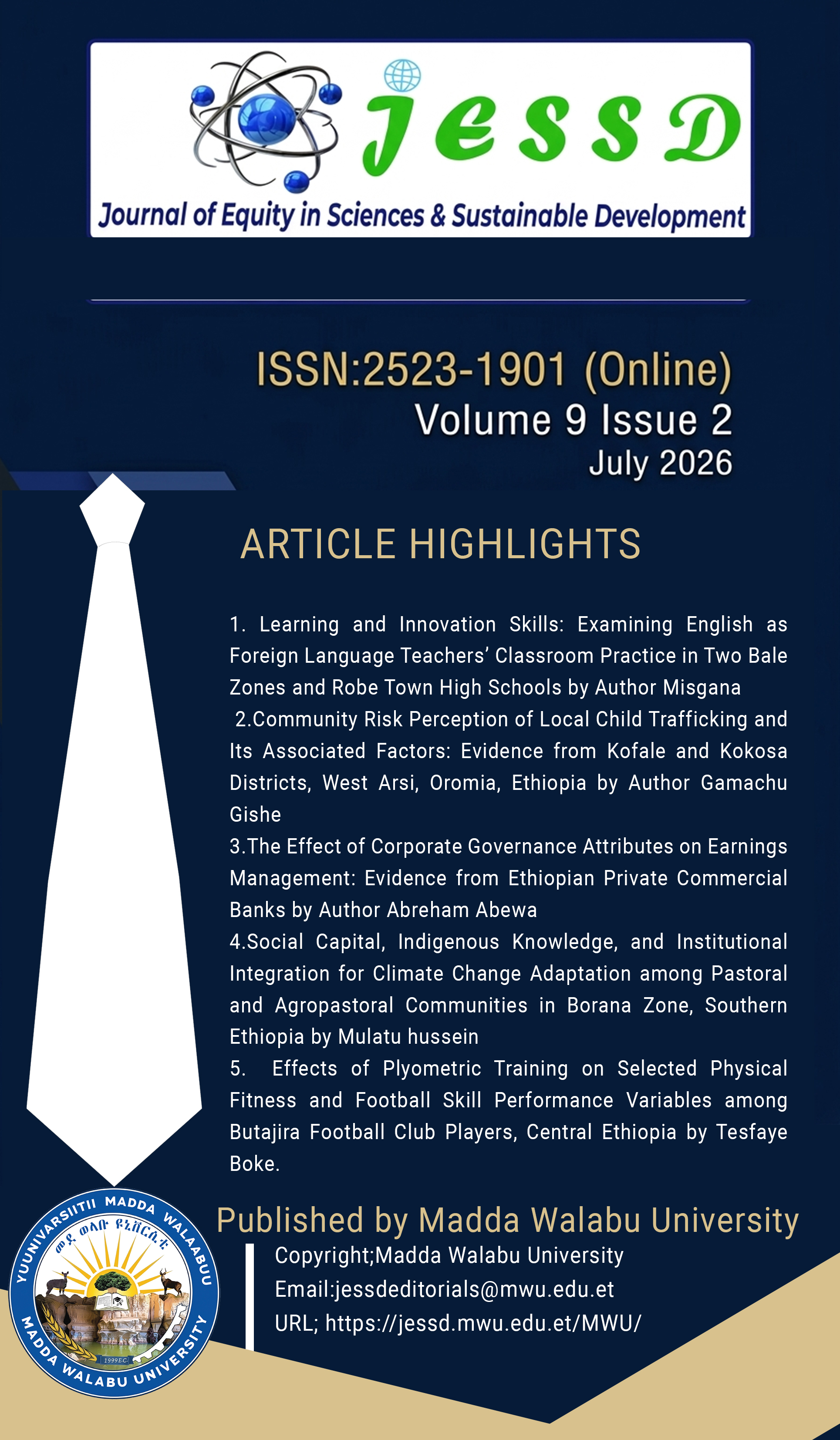
Learning and Innovation Skills: Examining English as Foreign Language Teachers’ Classroom Practice in Two Bale Zones and Robe Town High Schools
DOI:
https://doi.org/10.20372/mwu.jessd.2026.1599Keywords:
4Cs, Classroom, Essential skills, PracticeAbstract
Learning and innovation skills, or the 4Cs (critical thinking, communication, collaboration, and creativity), are essential for preparing students for future careers in the 21st century. This study aimed to examine English as a Foreign Language (EFL) teachers’ classroom practice of learning and innovation skills. An explanatory sequential design was used in this study, involving 25 teachers and 297 Grade 9 students. Structured observation, questionnaire, and semi-structured interview were used to collect data. Quantitative data were analyzed using SPSS version 25, and the outputs of observation and teachers’ responses were reported as percentages, while mean and standard deviation were described for students’ responses. Thematic analysis was made for interview results, followed by coding, categorizing, and interpreting. Finally, quantitative and qualitative findings were triangulated. The results of the study revealed that learning and innovation skills were infrequently practiced, as the majority of the calculated data fell within ‘never’ to ’sometimes’. Besides, survey results indicated that critical thinking (M=2.79, SD=.81158), communication (M=2.67, SD=.78912), collaboration (M=2.77, SD=.80971) and creativity (M=2.65, SD=.77871) skills were practiced occasionally. Among these skills, critical thinking skills, followed by collaboration skills, were the most frequently practiced skills. The findings further indicated limited use of digital technologies in classroom instruction. The use of digital technologies was also another missed ingredient. Thus, sufficient classroom practice of learning and innovation skills and digital technologies should be provided for students. Further research should also be conducted on how to fully engage students in practice and examine factors contributing to limited classroom practice.
Downloads
References
Akpan, V.I., Igwe, U.A., Mpamah, I.B.I. & Okoro, C.O. (2020). Social constructiv-ism: Implications on teaching and learn-ing. British Journal of Education, 8(8), pp.49-56, September 2020. https://eajournals.org/wp-content/uploads/Social-Constructivism.pdf
Andrade, Ch. (2018). Internal, external, and ecological validity in research design, conduct, and evaluation. Indian Journal of Psychological Medicine, 40 (5). DOI: 10.4103/IJPSYM.IJPSYM_334_18
Boone, H. N., & Boone, D. A. (2012). Ana-lyzing likert data. Journal of Extension, 50(2), 1-5. DOI: 10.34068/joe.50.02.48
Cavner, D. & Fox, J. (2014). 21st Century teaching and learning in Ethiopia: Challenges and hindrances. Conference paper in International Journal of Peda-gogy and Curriculum. https://www.researchgate.net/publication/281848070.
Chu, S.K.W., Reynolds, R.B., Tavares, N.J, Notari, M. & Lee, C.W.Y. (2017). 21st century skills development through in-quiry-based learning: From theory to practice. Springer.
Creswell, J. W. (2014). Research design: Qualitative, quantitative, and mixed methods approaches (4th ed.). Sage Pub-lications, Inc.
Creswell, J. W. & Creswell, J. D. (2018). Re-search design: Qualitative, quantitative, and mixed methods approaches (5th ed.). Sage Publications, Inc.
Cretu, D. (2017). Fostering 21st century skills for future teachers. The European proceedings of social & behavioral sci-ences EpSBS, Edu World 2016 7th Inter-national Conference. http://dx.doi.org/10.15405/epsbs.2017.05.02.82
Eaton, S.E. (2010). Global trends in lan-guage learning in the twenty-first centu-ry. Onate Press.
Fullan, M. & Langworthy. (2014).A Rich seam: how new pedagogies find deep learning. London: Pearson.
Fullan, M., Quinn, J., Drummy, M., Gardner, M. (2020). Education reimagined: The future of learning. A collaborative posi-tion paper between new pedagogies for deep learning and Mi-crosoft education. https://assets global.web-site files.com/61366d43ebd6df56d9b67a11/6174a35759f230265d63c74f_Microsoft-EducationReimagined-Paper.pdf.
Gay, L.R., Mills, G.E. & Airasian, P. (2012). Educational research: Competencies for analysis and application (10th ed,). Pearson Education.
Gunawan, I.M.A.A., Padmadewi, N.N. & Utami, I.G.A.L.P. (2022). The analysis of 4C skills representation in eleventh-grade senior high school's English text-book. JPBII, 10(1). DOI: 10.23887/jpbi.v10i1.883
Kane, M., Berryman, S., Goslin, D. & Melt-zer, A. (1990). The Secretary's Commis-sion on achieving necessary skills iden-tifying and Describing the Skills Re-quired by Work. Pelavin Associates, Inc.
Kapkir, F. (2024). Teaching 21st century skills in EFL classrooms: An investiga-tion of teacher, student and institutional perceptions on the instructional practices of the 4C skills (MA thesis). Middle East Technical University. https://open.metu.edu.tr/bitstream/handle/11511/109081/10628222.pdf
Kothari, C.R. (2004).Research methodology: Methods and techniques. New Age In-ternational (P) Ltd.
MoE. (2018). Ethiopian education develop-ment roadmap (2018-30). An integrated executive summary. FDRE.
MOE. (2020).General education curriculum framework. FDRE.
NDCTE.(2023).Preparing tomorrow’s workforce. https://www.cte.nd.gov/sites/www/files/documents/CareerReady/Entire_Career_Ready_Rubric_Document.pdf
Nowell, L.S., Norris, J.M., White, D.E. & Moules, N.J. (2017). Thematic analysis: Striving to meet the trustworthiness cri-teria. International Journal of Qualita-tive Methods, 16, 1-13. https://journals.sagepub.com/doi/10.1177/1609406917733847.
OECD. (2019). OECD future of education and skills 2030, OECD learning com-pass 2030: a se-ries of concept notes.https://www.oecd.org/content/dam/oecd/en/about/projects/edu/education-2040/1-1-learningcom-pass/OECD_Learning_Compass_2030_Concept_Note_Series.pdf
Orak, S.D. & Al-khresheh, M.H. (2021). In between 21st century skills and con-structivism in ELT: Designing a model derived from a narrative literature re-view. World Journal of English Lan-guage. https://doi.org/10.5430/wjel.v11n2p166.
P21. (2016). Framework for 21st century learning. Ohio Department of Educa-tion.https://www.battelleforkids.org/wpcontent/uploads/2023/11/P21_framework_0816_2pgs.pdf.
Ravitz, J. (2014). A survey for measuring 21st century teaching and learning: West Virginia 21st century teaching and learn-ing survey [WVDE-CIS-28]. Department of Education, West Virginia.https://www.battelleforkids.org/wpcontent/uploads/2023/11/P21_framework_0816_2pgs.pdf.
Robinson, K. (2011). Out of our minds: Learning to be creative (2nd ed.). Cap-stone.https://static1.squarespace.com/stat-ic/5df3bc9a62ff3e45ae9d2b06/t/5e88bb41d84e09477ed6997b/1586019144402/EBS+Out+o+four+Minds.pdf
Saimon, M., Lavicza, A. & Dana-Picard, T. (2023).Enhancing the 4Cs among col-lege students of a communication skills course in Tanzania through a project-based learning model. Education and Information Technologies, 28:6269–6285. https://doi.org/10.1007/s10639-022-11406-9
Sankar, C. (010).Business research methods. Vivekanandha college of arts and sci-ence for wom-en, Elayampalayam, tiruchengode-637205. file:///C:/Users/Dot%20com/Downloads/BRMfull-Sankar--converted.pdf
SCANS (1990). What work requires of schools: A SCANS for America 2000. Department of labor. https://files.eric.ed.gov/fulltext/ED332054.pdf
Scoular, C. (2020). Analysis of 21st century skills integration as applied in the Phil-ippines K to 12 program. Final report. Australian council for educational research. https://research.acer.edu.au/curriculumdevelopment/1
Shabrina, A. & Astuti, U.P. (2022).The inte-gration of 6Cs of the 21st century edu-cation into English skills: Teachers’ chal-lenges and solutions. Jurnal Pendidi-kan: Teori, Penelitian, Dan Pengem-bangan, 7(1), 28-37.DOI: 10.17977/jptpp.v7i1.15185
Shenton, A.K. (2004).Strategies for ensuring trustworthiness in qualitative research projects. Education for Information 22 (2004) 63–75.https://doi.org/10.3233/EFI-2004-22201
Shield, L. & Kukulska-Hulme, (2008). An overview of mobile assisted language learning: From content delivery to sup-ported collaboration and interaction. ReCALL, 20(3), 271-289. Available at: https://eric.ed.gov/?id=EJ812214 .DOI: 10.1017/S0958344008000335
Singh, Y.K. (2006). Fundamental of research methodology and statistics. New Age In-ternational (P) Ltd.
Stahl, N.A. & King, R. (2020). Expanding approaches for research: understanding and using trustworthiness in qualitative research. Journal of Developmental Ed-ucation. http://www.jstor.org/stable/45381095
Taherdoost, H. (2016). Validity and reliability of the research instrument; how to test the validation of a questionnaire/survey in a research. International journal of Academic Research in Management (IJARM), 2016, 5. Hal-02546799. . https://doi.org/10.2139/ssrn.3205040
Tai, Ph.T. (2023). EFL students’ perceptions and use of 21st century learning skills in learning English at a secondary school. International Journal On Studies In English Language and Literature (IJSELL), 11(6), pp. 18- 25. https://doi.org/10.20431/2347-3134.1106003
Trilling. & Fadel, C. (2009). 21st century skills learning for life in our times. John Wiley & Sons Inc.
Yohannes, S. (2019).Preparatory school learners’ level of critical thinking profi-ciency and its correlation with their aca-demic achievement in Ethiopia: The missing ingredient. English Language, Literature & Culture, 4(2), 32-38. https://doi.org/10.11648/j.ellc.20190402.11
Youngsang, Ch. & Eunim, B. (2025). Un-packing class activities that foster the practice of the 4cs in a general English course: Students’ perspectives. Journal of Korea English Education, 19(5), 85-101. https://doi.org/10.46392/kjge.2025.19.5.85
Zohrabi, M. (2013).Mixed method research: Instruments, validity, reliability and re-porting findings. Theory and Practice in Language Studies, 3 (2), pp. 254-262. doi:10.4304/tpls.3.2.254-262.
Additional Files
Published
How to Cite
Issue
Section
License
Copyright (c) 2026 JESSD

This work is licensed under a Creative Commons Attribution-NonCommercial 4.0 International License.


